Magazine

Spray coating

Article

Industrial Spray Coating: The Definitive Guide to Techniques and Equipment

More and more manufacturers are choosing to install industrial spray coating systems within their finishing lines. Precision, flexibility, reliability and efficiency are, after all, the watchwords of a technology that, thanks to automation, can be adapted for a myriad of applications and sectors.

Naturally, to maximise output, it is fundamental to design plants and processes that take into account the unique features of the machinery and to integrate them according to production goals.

But what does it take to plan an evolutionary path that is consistent with your growth strategy? Which solutions are best to adopt to meet the needs of your specific sector?

To answer this question, we have prepared a complete guide to the techniques, equipment and use cases that revolve around the subject of industrial spray coating.

What is industrial spray coating?

Let's start by framing the topic from a technical point of view. Industrial spray coating is a manufacturing process that involves applying liquid or powder coatings to surfaces using specialised spray equipment. Unlike more traditional methods (for example, dip, brush or roller coating), industrial spray coating atomises the lacquer into fine droplets that are then transferred onto the substrates. This achieves rapid, uniform coverage on large and complex surfaces. (To learn more about this topic, we have dedicated an entire White Paper to the subject of painting complex shapes.)
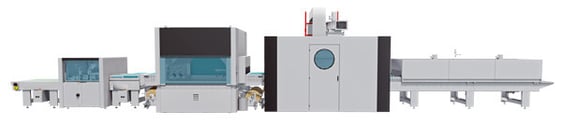
R-LineaIWF Cefla Finishing coating line

Returning to industrial spray coating, the dynamics of this technology vary depending on the application for which it is implemented. In general, spray coatings provide smooth, glossy finishes for a wide range of manufactured goods, from consumer products to vehicle components, to furniture and furnishing accessories. Some coatings are formulated to perform specific functions, such as thermal insulation, electrical conductivity or non-slip properties. But there are even more particular use cases, such as the aerospace industry, as the technique, when applied with suitable materials, offers effective protection against corrosion, wear, chemical exposure and environmental factors, significantly extending the service life of products.

Industrial spray coating is increasingly valued as it supports mass production with consistent results, reduces labour costs and allows for precise control over coating thickness. Its versatility, as we will see, makes it suitable for a wide range of substrates, from metals and plastics to concrete, and for various applications.

DISCOVER THE MOST ADVANCED FINISHING SOLUTIONS
Elevate your competitive edge.

Advantages of industrial spray coating

Industrial spray coating offers numerous advantages over other finishing methods. Firstly, as mentioned, its application versatility makes it possible to easily coat complex geometries, intricate components and large surfaces uniformly, a result that is difficult to achieve, for example, by brushing or dipping. This flexibility is essential for production lines that must handle objects with irregular three-dimensional shapes, such as car body panels and interior elements of motor vehicles.

But, compared to other approaches, spray coating also ensures greater performance in terms of speed and efficiency. The process can indeed be automated, which ensures high productivity and consistent results. Within a custom-designed line, spray painting can rapidly cover large surfaces, drastically reducing delivery times for large batches.

Among the plus points of industrial spray coating, one has to mention the uniformity of the applied material layer; atomisation guarantees a homogenous coating thickness, regardless of the coating material used. And, still on the subject of consumables, the wide range of materials compatible with spray coating – epoxies, polyurethanes, acrylics, zinc-rich primers and powders – allows for the creation of tailor-made solutions based on specific functional requirements:

  • resistance to corrosion and abrasion from chemical agents
  • durability over time, even in conditions that involve exposure to UV rays
  • high-quality tactile and visual properties
  • and finally, robustness

This is thanks to the ability to control the desired thickness with extreme precision, which allows manufacturers to optimise material usage and meet its performance standards.

So, in brief, the advantages offered by industrial spray coating are:

  • Process speed and efficiency
  • Application uniformity on complex surfaces
  • Wide range of applicable materials
  • Thickness control
  • Resistance to wear, UV, and chemical agents
  • Increased durability of treated surfaces
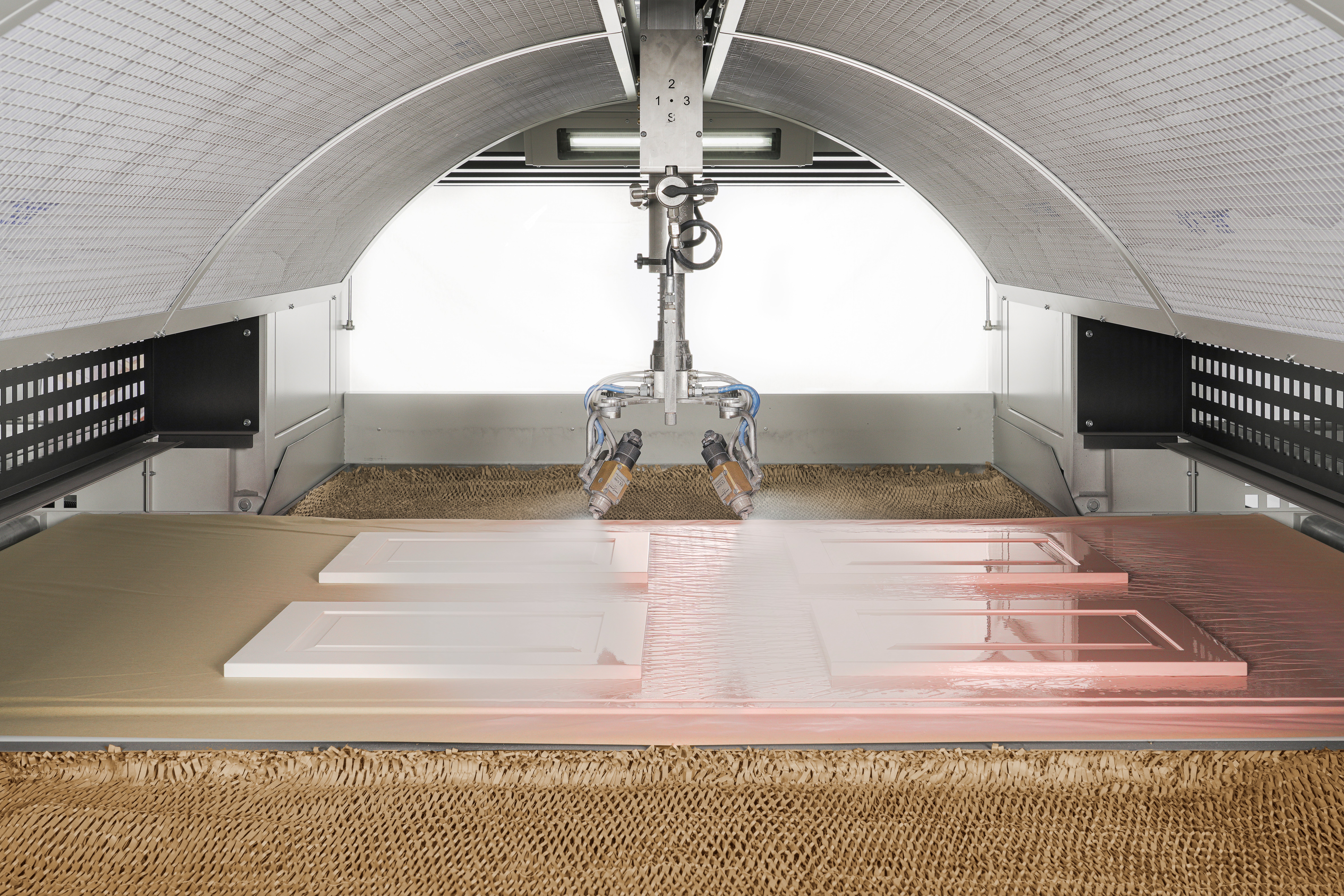
 

Cefla Finishing PRIMA machine

Common industrial spray coating techniques

Obviously, the choice and correct use of the most appropriate technique are fundamental to achieving the optimum result. Understanding the operating principle of each approach – which naturally has its advantages and disadvantages, and which is therefore more or less suitable for certain applications – is the prerequisite for maximising the performance of the coating materials on the objects to be treated.

Here is a quick reference guide to the most common painting techniques, all of which are covered by Cefla Finishing technologies and machines, with advanced and customisable solutions.

➡️Conventional Air Spray

The most basic technique uses compressed air to atomise the coating material as it exits a spray gun. In its simplicity, it guarantees excellent coverage and is extremely versatile even when using different coating types. The approach, common in general finishing operations, vehicle painting and architectural coatings, has two potential disadvantages: overspray and higher material consumption which, if not properly managed, can lead to unwanted waste.

➡️HVLP (High Volume Low Pressure)

To overcome the limits of conventional spray coating techniques, companies can turn to HVLP systems, which use a high volume of air at low pressure to produce extremely fine droplets with a controlled spray. The technique thus offers superior transfer efficiency and reduces overspray, making it ideal for precision work, furniture finishing and touch-up applications. However, you might experience a slower transfer speed for thicker coatings.

➡️Airless Spray

This approach relies on high-pressure pumps to force the coating through a nozzle without compressed air. It provides rapid coverage for large surfaces, such as industrial tanks or structural steel. The main advantage of airless spray is its high productivity; however, it can produce overspray and may not guarantee optimal finish control.

➡️Air-Assisted Spraying

This procedure, as the name suggests, combines the two aforementioned techniques (airless and conventional), using low-pressure air to further atomise the coating and improve the quality and control of the finish. Machines of this type are suitable for creating coatings that require a smooth, high-quality surface.

➡️Electrostatic Spraying

By electrically charging the coating particles, it is possible to attract them to the surfaces to be treated, ensuring greater transfer efficiency and minimal waste. Electrostatic spraying is therefore ideal for handling objects with complex shapes, such as vehicle panels and large metal structures. The resulting coating is excellent, with a drastic reduction in overspray. The main challenge in implementing this approach is the cost of the equipment and its maintenance.

Types of paints usable in industrial spray coating

The knowledgeable use of various industrial spray coating techniques allows for the adoption of a wide range of coating materials, each suitable for specific applications. Let's see which are the most common:

  • Epoxy paints Known for their excellent chemical and corrosion resistance, epoxies are widely used in protective coatings for pipelines, tanks and concrete structures. They cure to form durable, high-adhesion films.
  • Polyurethane paints Offering excellent abrasion resistance and UV stability, polyurethanes are common in automotive finishes, floor coatings and outdoor equipment. They provide flexible, glossy finishes.
  • Acrylic paints Valued for their ease of application, quick drying and colour retention, acrylic coatings are used in architectural finishes, signage and decorative applications.
  • Alkyds These are traditional oil-based coatings that offer good gloss and ease of application, often used on furniture, machinery and in general industrial applications where aesthetics is important.
  • Zinc-rich primers These materials contain high levels of zinc particles for galvanic protection, preventing corrosion on steel structures, bridges and offshore platforms.
  • Powder coatings (if applicable with electrostatic spraying) Applied via electrostatic spraying, powders derived from polyester, epoxy resin or thermoplastic materials produce durable and environmentally friendly finishes, particularly suitable for domestic appliances, automotive components and heavy machinery.
  • Other special materials Finally, there are special coatings that offer specific properties (non-stick, heat or wear resistance) used in sectors such as the food industry, electronics or in high-temperature environments.

Industrial spray coating equipment

At the heart of an efficient, high-performance line, there is, of course, reliable and robust industrial spray coating equipment, designed to ensure quality and safety within increasingly integrated and automated processes. Here is an overview of the essential components for each of the techniques we have seen so far.

➡️Spray guns

To be selected based on the chosen technique, spray guns are divided into different categories: compressed air guns for conventional methods, HVLP guns for precision work, air-assisted guns, airless guns and finally, electrostatic guns.

➡️Material Feed Systems

We are talking about pumps (piston, diaphragm or centrifugal) and pressure pots, which supply the coating material consistently and at the desired pressure. For dispensing powder coatings, there are specialised feeders capable of ensuring a constant flow.

➡️Hoses

Essential for resisting chemical attack and pressure fluctuations, high-performance hoses connect the pumps to the spray guns.

➡️Nozzles

Depending on the type of application and material used, the guns are equipped with nozzles of different sizes and designs, which influence the spray pattern and material atomisation. Knowing how to choose the correct option is fundamental to obtaining uniform coatings.

➡️Air Preparation Equipment

Compressors, filters and dryers ensure a supply of clean, dry and regulated air, which is essential for achieving consistent spray quality and ensuring the longevity of the equipment.

➡️Surface Preparation Tools

Abrasives, detergents and primers, to be applied to substrates before spraying operations, are fundamental for ensuring optimal adhesion and coating performance.

➡️Spray Booths and Ventilation Systems

These machines not only help to reduce overspray but also to control the fumes generated by spraying, helping to keep work environments safe. Operating in tandem with adequate filtration mechanisms, they minimise the environmental impact and health risks for coating operators.

➡️Personal Protective Equipment

For those working in close contact with industrial spray coating equipment, respirators, gloves, overalls and protective goggles remain essential to avoid contact with particles that are hazardous to the skin and respiratory system.
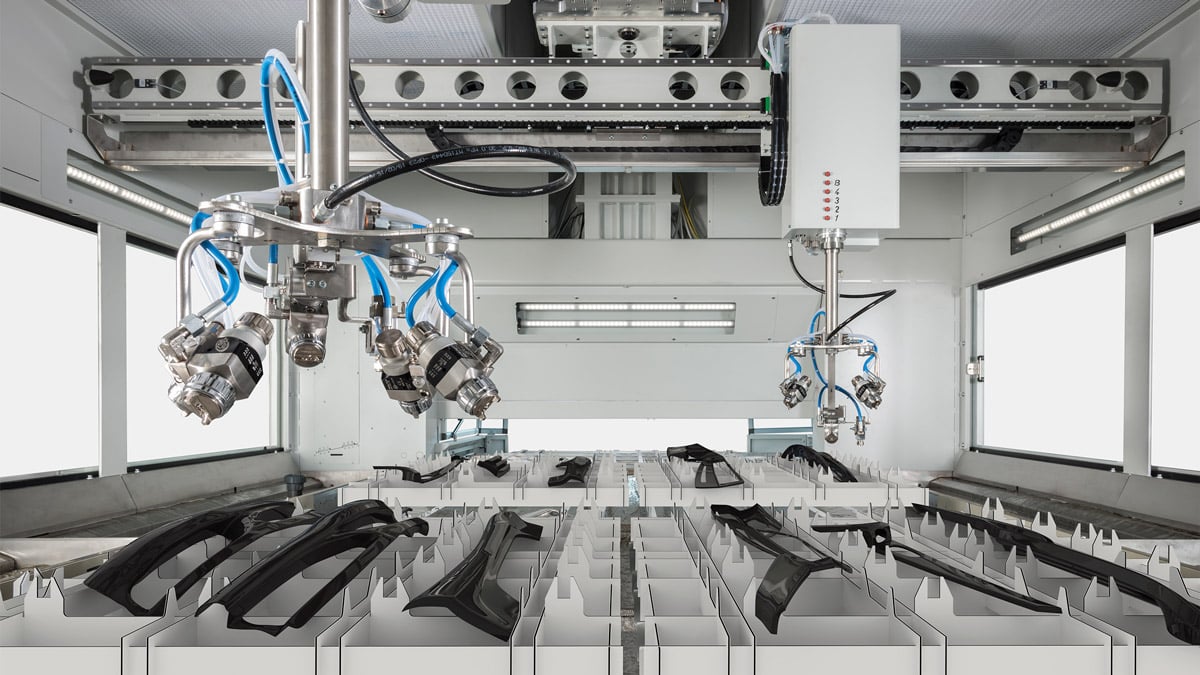
Coating machine for automotive

Industrial sectors and applications of spray coating

This guide to industrial spray coating can only conclude with an overview of the most popular applications in an ever-growing number of sectors. We are talking about extremely heterogeneous sectors, each with specific requirements, but all distinguished by a common need: to achieve maximum production efficiency without ever compromising on the quality of the finished product, the safety of their employees and eco-sustainability.

While in the automotive sector these techniques have been used for years for painting car bodies and applying clear coats and protective finishes, ensuring both pleasing aesthetics and corrosion resistance, in the aerospace sector, spraying allows aircraft components to be coated with specialised, lightweight and high-performance paints.

The marine industry is also discovering its advantages: the application of antifouling paints and protective coatings helps ships and offshore structures to resist microorganisms and the constant corrosive action of salt water.

Those in the manufacturing industry, on the other hand, use spray painting to apply protective and decorative coatings to machinery, domestic appliances and consumer products, while in the construction sector, the technique is used to coat structural steel and concrete surfaces or fibre cement elements with oxidation-resistant paints and protective layers.

With the aim of obtaining high-quality finishes on wooden and metal furniture, combining durability and pleasing aesthetics, the world of furniture and domestic appliances is also experiencing the benefits of industrial spray coating first-hand.

Then there are use cases that could be defined as extreme, such as applications in the heavy machinery and Oil & Gas sectors: industrial spray coating is currently the best option for creating coatings capable of protecting pipelines, offshore platforms and storage tanks from corrosion and chemical attack. Thanks to the use of zinc-rich primers and epoxy coatings, these treatments help equipment to withstand environmental damage, wear and chemical exposure, even over a very long period of time.

Each of the aforementioned sectors can, of course, only unleash the full potential of industrial spray coating when it designs and implements customised coating solutions, that is, ones capable of adhering to industry standards and the requirements imposed by clients. This is why it is essential to be able to rely on a partner like Cefla Finishing: our offering is constantly evolving, and aims not only to provide the market with a high-level technological supply, but above all to build, together with our customers, solutions capable of successfully tackling new and increasingly challenging use cases.

LOOKING FOR THE IDEAL SOLUTION FOR YOUR COATING LINE?


More and more manufacturers are choosing to install industrial spray coating systems within their finishing lines. Precision, flexibility, ...

Article

Eyeglass coating: plastic finishing solutions and much more

Everyone involved in eyeglass coating knows perfectly well that it is, perhaps, the most decisive process when it comes to giving the final product aesthetic appeal. Design and materials are certainly crucial when it comes to building a good frame. However, vibrant colours, high-quality finishes and the right ‘feel’ are equally decisive factors, leading consumers to choose products that will match their own look and, possibly, improve it.

In other words, aesthetics are as important as the practical, protective characteristics provided by the coating process.

The major brands are well aware of this: that’s why they’re always looking for partners who can guarantee an optimal approach to eyeglass coating, minimising costs but without ever compromising on quality.

This article explores the main coating techniques used on plastic eyeglasses (and those made of other materials). It also illustrates how Cefla Finishing - by drawing on decades of experience and constantly striving to improve the efficiency and performance of finishing lines - has succeeded in designing an advanced system with customisable configurations.

ComplexGeometries#1-Mockup

Want to discover the universe of objects with complex geometric shapes that are coated with Cefla Finishing equipment?


The main eyeglass coating techniques

First of all, note that different techniques can be used to treat these semi-finished products, whether they be complete frames or individual components. However, if the goal is to achieve premium-level quality, it’s essential that plastic eyeglass coating be performed inside a pressurized area that is sealed off from the external environment.

In many cases it’s preferable to use a liquid coating as it allows fast drying, even at relatively low temperatures. Not only that, it ensures impeccable output on any type of material, guaranteeing a broad range of aesthetic results, from RAL colours and metallic/iridescent effects to soft-touch finishes.

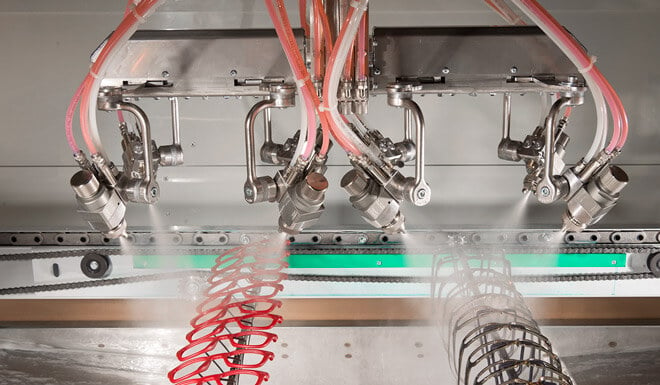
Sunglass_pistole10

Liquid coating is usually applied by spraying. This can be done using machines or by way of manual techniques, depending on the type of product being made.

Regardless of the type of process, the coating will have to be dried. For this reason, semi-finished products need to be placed, in series, in one or more ovens before proceeding to the next stage, which usually consists of polishing.

How to maximise eyeglass coating process flexibility (on plastic or other materials)

These are the most popular methods when it comes to plastic eyeglass coating: traditional approaches that have pros and cons, to be carefully assessed before starting up a finishing line. And then there's the Cefla Finishing approach, which has resulted in the development of an integrated solution that combines productivity, efficiency and precision.

On the Cefla-designed line, in fact, the various eyeglass components are attached to a rotating support. This is positioned underneath a series of spray guns, which coat them at high speed while any overspray is controlled and minimised using water filtration. The ability to configure the machines according to specific finishing requirements ensures coating is performed efficiently without having to program special trajectories.

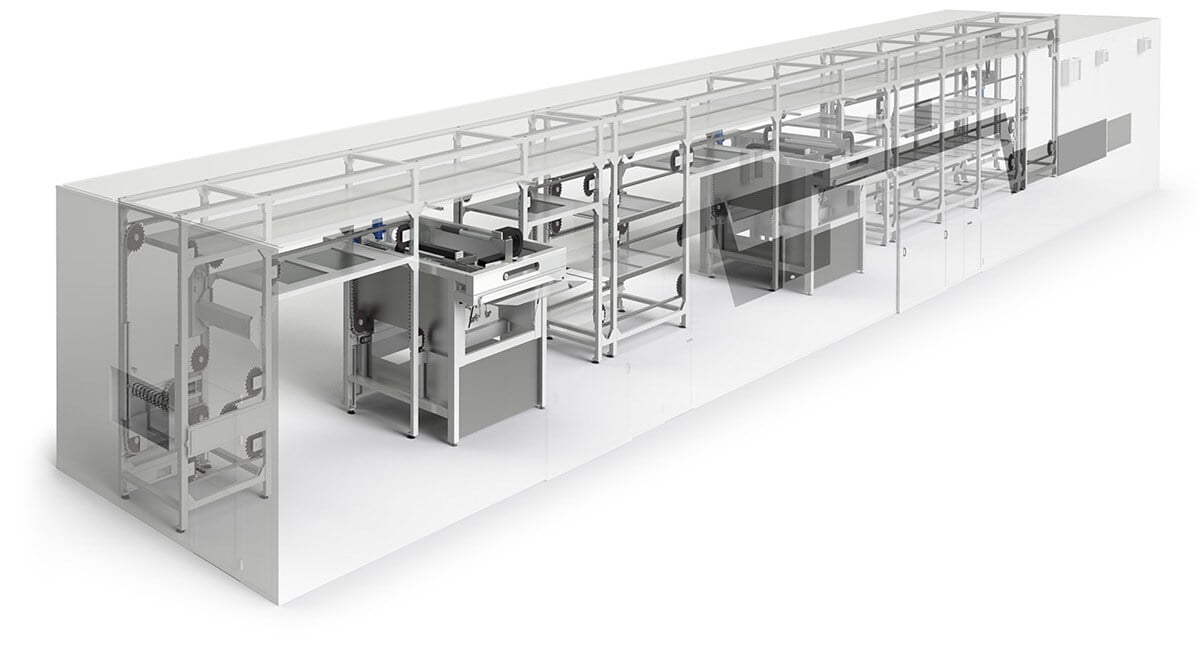
RENDER-Linea-Occhiali-2

All this takes place inside a pressurized, air-conditioned zone, ensuring the correct ambient conditions for the process in use. The system can also rapidly be adapted to different types of coatings. Moreover, simplified format changeover procedures guarantee greater flexibility.

By leveraging an integrated, fully automatic system, this approach improves energy/raw material management and delivers high-quality coating.

Which machines are used to coat eyeglasses? Building a high-performance line

The line designed by Cefla Finishing includes highly specialised machines. These are designed to simplify control of every step in the coating process, for eyeglasses or other objects of complex shape.

Let’s begin with iBotic, the one- or two-arm Cartesian spraying robot with interpolated axes that’s perfect for high output capacities and maximum quality. This machine stands out for its capacity to simultaneously process pieces of different shape and thickness, with the conveyor either at standstill or on the move, in tracking mode. Lastly, the passage in the oven features Aquadry technology, a combined in-line system that merges the effectiveness of high-speed hot air with the high radiant capacity of infra-red lamps. This is the most efficient acrylic coating drying method as it requires less time to evaporate the water contained in the coatings.

Cefla Finishing and tailor-made solutions to coat plastic eyeglasses and other items

The above is just one example of the potential of a dedicated metal and plastic eyeglass coating line. Thanks also to a vast selection of finishing solutions and a 3000 m2 lab facility where customers can engage in hands-on experimentation and development of customised equipment, Cefla Finishing is able to adapt each process technology to most of the market’s specific needs.

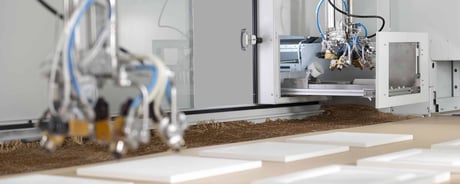
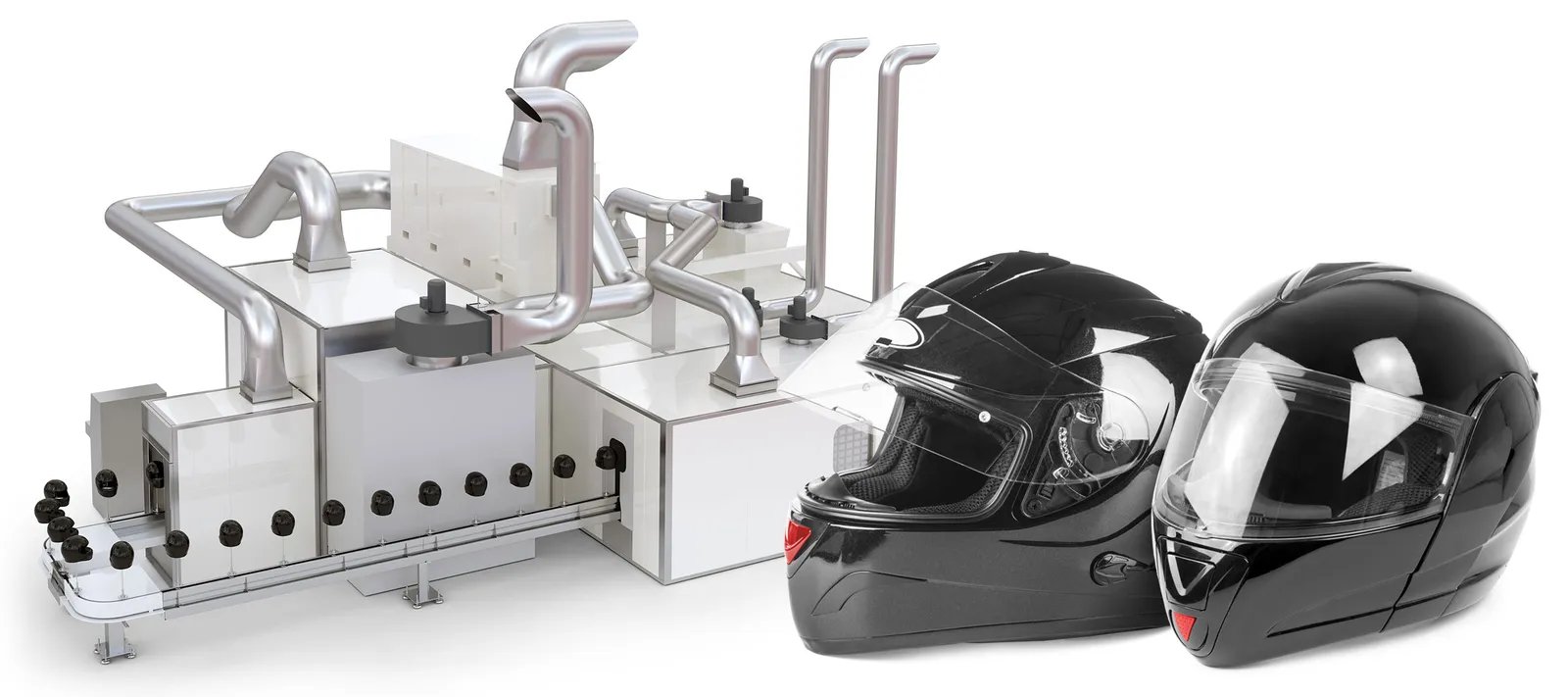
By leveraging a constantly-evolving machine range, it’s possible to use in-depth technological integration to optimise not just the coating of eyeglasses but also the finishing of wooden furnishing accessories, helmets, musical instruments, solar panels, car dashboards and ceramic slabs. In other words, the opportunities are practically limitless: all you need to do is contact one of our experts and come and see how the Cefla range can help you take your business to the next level!

LOOKING FOR THE IDEAL SOLUTION FOR YOUR COATING LINE?

Everyone involved in eyeglass coating knows perfectly well that it is, perhaps, the most decisive process when it comes to giving the final product ...

Article

What is a Cartesian robot and what are its advantages in spray painting?


The finishing sector is undergoing a radical transformation. Thanks to automation and digital technologies, the Cartesian robot is becoming increasingly central to industrial painting processes and, in particular, spray coating.

These systems not only improve the precision and uniformity of the paint, but also help companies reduce energy consumption, increasing the efficiency of production lines. In this article, we will explore how Cartesian robots can bring advantages in terms of energy savings in spraying and energy recovery in painting.

What is a Cartesian robot?

A Cartesian robot (also called a linear or gantry robot) is a robotic system that moves along three orthogonal axes: X, Y and Z. This allows the robot to move in a linear and precise way in three-dimensional space. Its structure is composed of a frame that supports a mobile platform. This platform can move along the axes, allowing the robot to perform tasks such as picking, placing or assembling components with great precision.

Cartesian robots are easy to program and highly repeatable, which makes them ideal for industrial applications such as manufacturing, packaging, material handling and painting. In the latter application, the robots minimise overspray by applying paint only where it is needed. This not only reduces material waste but also allows for energy savings.

THE MOST INNOVATIVE FINISHING SOLUTIONS
Discover the most advanced finishing solutions to boost your competitiveness.

How does a Cartesian robot work?

The Cartesian robot moves along the three axes thanks to motors that drive the platform precisely. The integrated control system guides the stepper or servo motors to perform movements accurately. This makes the robot ideal for pick-and-place and painting operations.

In an industrial context, the Cartesian robot can be programmed to pick components from a conveyor and position them with precision. Furthermore, some robots like iBotic are equipped with self-programming functions, which increases efficiency and reduces errors.

The advantages offered by a Cartesian robot

Cartesian robots offer many advantages. Here are the main ones:

  • Superior precision: The precise movements lead to high-quality finishes that are difficult to achieve with manual methods.
  • Increased operational efficiency: By automating repetitive tasks, downtime is reduced and efficiency is improved.
  • Sustainability: Cartesian robots reduce the carbon footprint thanks to energy savings and the reduction of waste and volatile compounds in the air.

Ease of integration: These robots adapt easily to existing processes

Energy saving in spraying

One of the main advantages of Cartesian robots in painting is the reduction of waste. Thanks to precise control of the spray pattern and application distance, the robots limit overspray and ensure that paint is deposited only where needed.

This leads to a reduction in material consumption and energy savings by limiting additional touch-ups. Furthermore, the use of advanced software allows for the optimisation of paint and solvent mixing, adapting them to temperature and humidity conditions. This ensures optimal paint application, further reducing consumption.

Powerback systems: energy recovery in painting

Another great advantage of Cartesian robots is energy recovery through powerback technology. During the process, a portion of the energy that would normally be lost, such as during deceleration, is stored and then made available to other systems and therefore reused.

This improvement in energy efficiency significantly reduces operating costs. Powerback systems use sensors and algorithms to monitor energy consumption in real time, capturing excess energy to reuse it in other phases of the production process. This not only lowers costs but also contributes to more sustainable production.


The new iBotic: efficiency and reduced consumption

Cefla Finishing has developed iBotic, a high-performance Cartesian robot that has revolutionised the spray-painting sector. Thanks to an updated user interface and an integrated energy recovery system, iBotic is able to optimise efficiency and reduce consumption.

One of the most interesting new features is Timeskip, a device that allows for colour changes without interrupting production. One arm goes into stand-by for cleaning, while the other continues to paint, recovering up to 90 minutes of production time per shift!

A practical demonstration of this technology? Discover how the company Pianca managed to reduce production costs and maintain the same standards of quality, customisation and impeccable service with Timeskip: discover the Case Study.

New functions for greater productivity

The new functions of iBotic have been developed based on customer needs. The innovations include:

  • Spray angle adjustment: Automatically adapts the paint application to different shapes.
  • Quick gun cleaning: Optimises colour changes and reduces downtime.
  • Simplified maintenance: The water circulation system reduces areas of stagnation, improving cleaning.

These functions increase productivity and efficiency, making the robot ideal for meeting the growing demand for customised production.

✅New user interface

The iBotic user interface has been designed to be simple and intuitive. Operators can easily manage and program the robot, with rapid learning and without the need for complex training. Furthermore, iBotic integrates seamlessly with ERP systems for optimal production management.

✅Energy recovery system: reduction of running costs

Of course, a powerback system has also been implemented on the new iBotic, which allows for energy savings of 15-20%, reducing operating costs and increasing overall sustainability.

Discover more on iBotic in this webinar.

In summary, the Cartesian robot represents an innovative solution for the painting sector, offering advantages in terms of energy savings, efficiency and superior performance. With the adoption of advanced technologies such as energy recovery, manufacturers can not only reduce costs but also improve the sustainability of their operations.

LOOKING FOR THE IDEAL SOLUTION FOR YOUR PAINTING LINE?


The finishing sector is undergoing a radical transformation. Thanks to automation and digital technologies, the Cartesian robot is becoming ...

Article

Automated coating line and solutions for spray systems

Innovation in coating automation now offers companies a breakthrough in terms of efficiency, quality and flexibility. Thanks to advanced systems, it is possible to manage even three-dimensional or irregular objects in a standardised and repeatable way, reducing labour costs. In this article, discover how an automated coating line can transform production by adding value, safety and control over the entire process.

What is an automated coating line?

Before we get into the specifics and discover the advantages of implementing an automated coating line, let's define the type of solution we are talking about.

An automated coating line usually refers to a fully integrated system designed to perform coating operations with minimal human intervention. Unlike traditional manual spray-painting processes, an automated coating system incorporates sophisticated handling, spraying and drying mechanisms to optimise the entire process. These architectures are often equipped with conveyor or robotic transfer mechanisms, which move parts seamlessly through the different stages, ensuring uniform coverage even on complex or irregularly shaped products.

The main advantage of an automated spray coating line lies in its ability to replace manual operations with precise and repeatable actions. Automated coating systems use programmable controllers to regulate spray parameters, movement trajectories and drying conditions.

automated lines for coating

Key components of a spray coating line

The latest generation of spray coating solutions are true technological ecosystems: a complete line includes several integrated elements that work in a complementary and harmonious way. Reviewing the key components of automated coating systems, we can certainly mention:

  • Automated spray booths: enclosed environments with controlled airflow and ventilation, designed to optimise spraying conditions and ensure uniform coating application.
  • Reciprocators and robotic spray arms: programmable mechanical devices to move spray guns precisely along complex paths, essential for intricate geometries.
  • Automatic spray guns: high-precision nozzles, adjustable for various coating materials and product shapes.
  • UV curing systems and drying units: for rapid polymerisation of coatings and efficient curing, reducing cycle times.
  • Conveyor or handling systems: automated devices for transferring parts through the various stages of the line, maintaining flow and precision.

Each component can be customised according to the application's requirements, making automated spray coating systems adaptable to different sectors and product complexities.

coating for irregular shapes


THE MOST INNOVATIVE FINISHING SOLUTIONS

Advantages of automated coating systems

Thanks to the synergy of these machines, automated coating systems offer numerous advantages. We are essentially talking about advances that have a direct and measurable impact on product quality and operational efficiency, which ultimately generate substantial economic benefits.

In particular, thanks to an advanced spray line, it is possible to achieve:

  • Superior finish: automated painting = uniform, defect-free layers even on irregular surfaces; less reworking and retouching.
  • Accelerated processing times: automated systems complete cycles more quickly than manual methods; greater productivity.
  • Material efficiency: precise control of parameters, less overspray and less waste, lower material cost.
  • Uniform application: constant thickness on every piece, even on complex shapes, thanks to programming.
  • Minimal labour for handling: automatic positioning allows operators to focus on strategic stages of the process.
  • Greater safety: workers are less exposed to hazardous fumes and overspray, creating a safer environment.
  • Flexibility and customisation: suitable for numerous substrates, coatings, geometries and sectors (automotive, aerospace, consumer electronics).

These are the advantages that, in general, can be obtained by integrating an automated coating line. But it is when the solution is customised that the true potential is unleashed.

examples of irregular shapes to coat

Ground-level lines facilitate the coating process

Cefla Finishing builds its offering on modularity and customisation. Floor-fixed spray lines are custom-designed and assembled for every need. This flexibility allows us to specifically follow the customer's product, developing automated lines based on process objectives.

When customising the line, Cefla integrates the best spray coating technologies, such as the iGiotto robot or, on request, machinery developed with third parties. A 3D scanner reads the shape of complex products, sets the spray trajectories and repeats them over the entire batch. A concrete example: an automated line in an automotive components factory achieves high quality on complex body panels and reduces cycle times and waste. In the absence of automation, the operator has to move around the piece, position it, paint it by hand, and transfer it to be dried. The automatic line, however, allows the product to move and rotate, with the robot painting it seamlessly, right through to the drying stage.

Customisation and integration for various industrial sectors

The automotive sector is just one of the fields where automated coating systems are a winning use case. Automatic coating lines are extremely versatile and adaptable.

  • In the aerospace sector, automated systems coat complex components with tight weight and performance tolerances.
  • Consumer goods manufacturers use flexible solutions to handle many types of products, even small or complex ones.
  • In industry, these systems are used to coat large mechanical components with irregular geometries.

Configurable options (multi-axis robotic arms, adjustable parameters, modular stations) help every manufacturer to optimise results on any material and coating. All this versatility stems from the modular approach and seamless integration into existing production lines, allowing for optimised workflows.

Some examples of our floor-fixed coating solutions

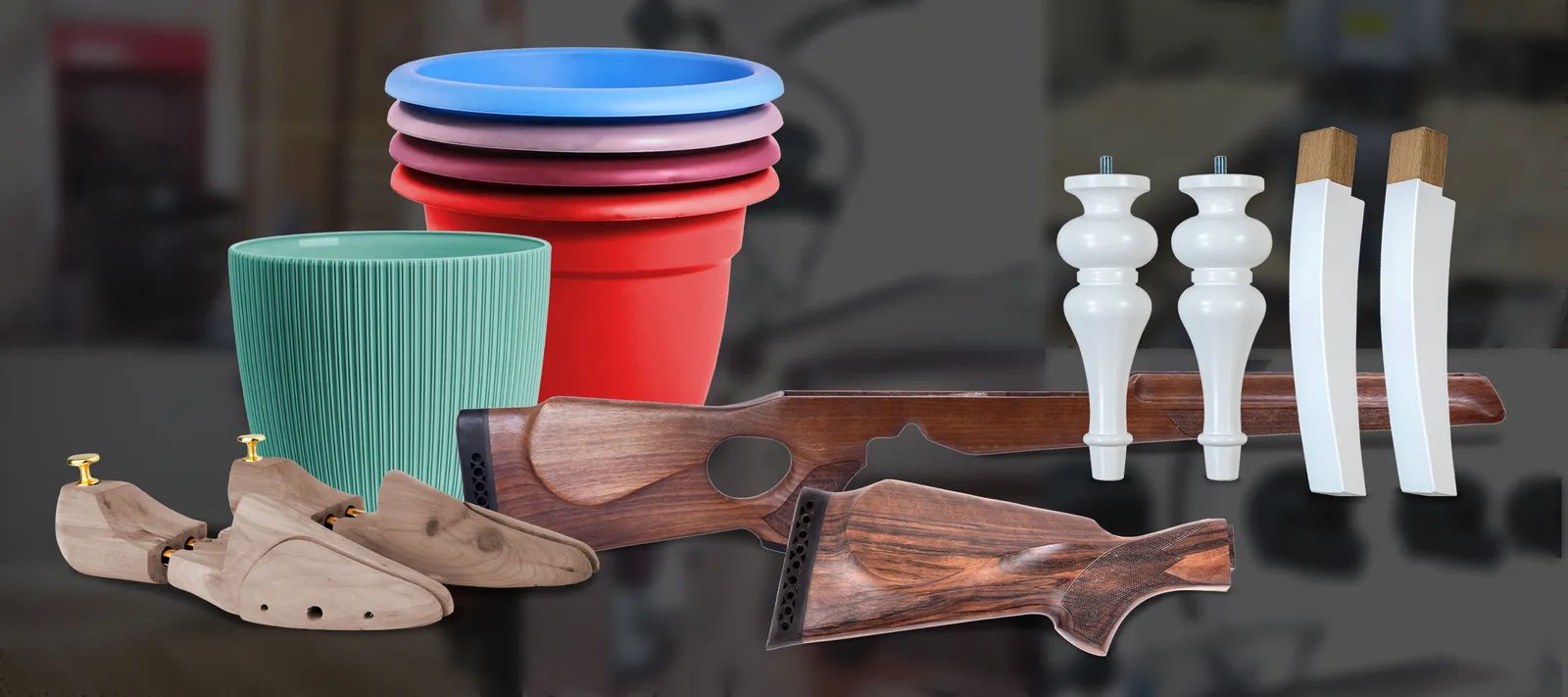
Given the multitude of cases in which a customised line can be successfully implemented, Cefla Finishing offers pre-configured solutions for many real needs already found on the market. The following can be processed on our automated coating lines:

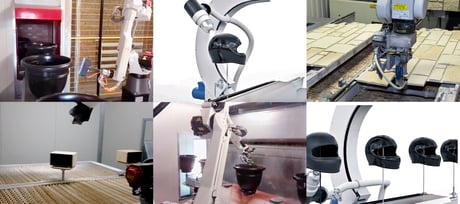
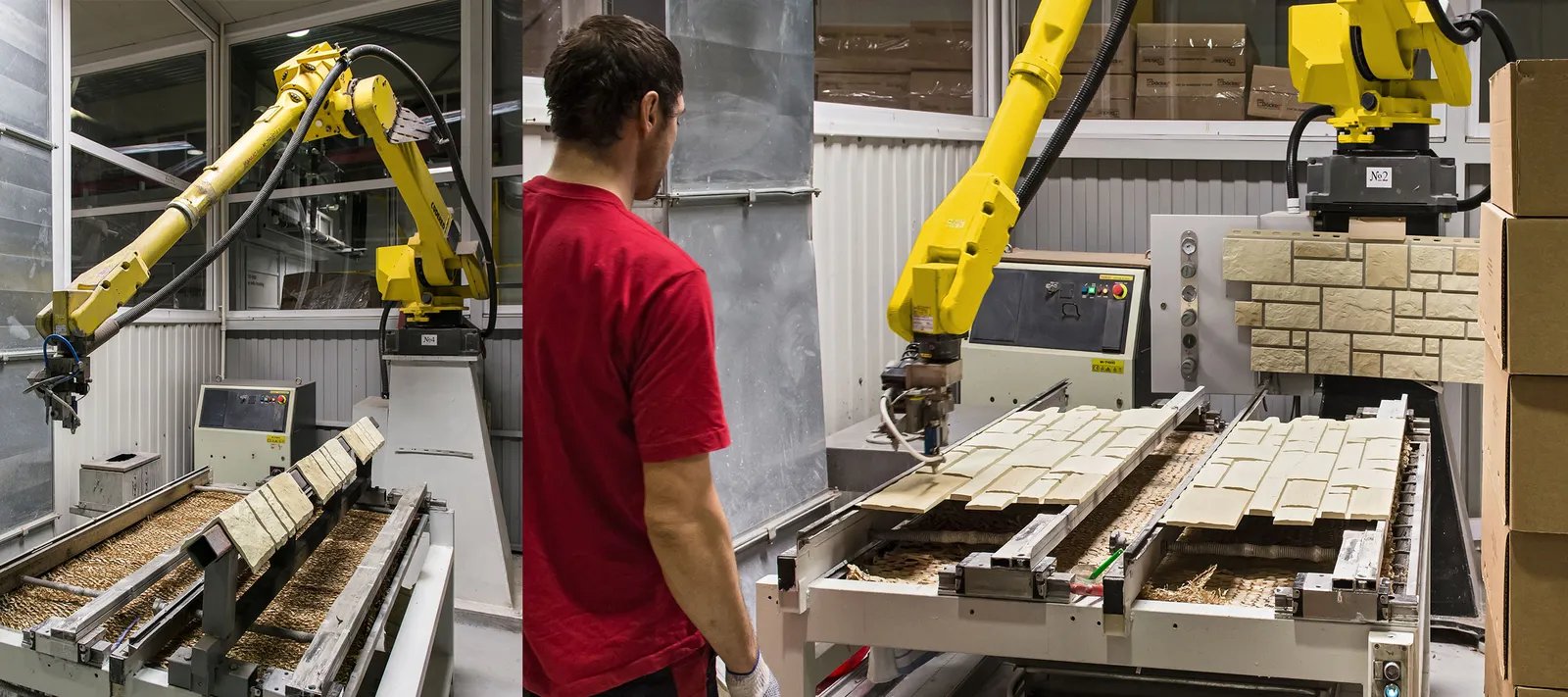
  • Motorcycle helmets
  • Sofa legs
  • Plastic flower pots
  • Rifle stocks
  • Pianos and grand pianos
  • Shoe trees
  • Coffins and caskets
  • Sidings
  • and much more.

Rely on our experience to find a tailor-made solution

Cefla Finishing has years of experience in creating automated coating lines, both overhead and floor-fixed. Every solution is developed based on the customer's specific requests: every product is different; therefore, coating and drying techniques change. We do not offer standard solutions, but rather tailor-made projects created thanks to proven experience and international technological know-how.

LOOKING FOR THE IDEAL SOLUTION FOR YOUR COATING LINE?
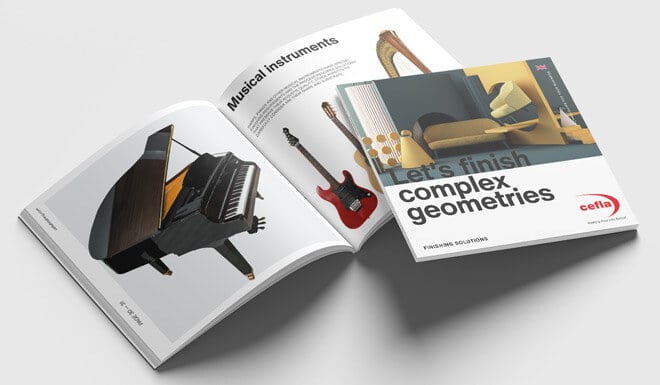
Innovation in coating automation now offers companies a breakthrough in terms of efficiency, quality and flexibility. Thanks to advanced systems, it ...

Article

Coating solutions: overhead lines, robotics and automation

Door/window manufacturers and sub-contractors who finish intermediate wooden or PVC products are always looking for new coating solutions: integrated machines and lines that not only ensure the best possible output but also allow them to create products that genuinely meet each customer’s specific needs. Solutions such as these deliver true innovation to the industrial coating sector.

Innovation in industrial coating

Today’s challenge consists of simplifying the industrial coating process with groundbreaking solutions, taking into consideration several parameters:

  • production volumes
  • demand for flexibility
  • type of substrate
  • specific requisites of final products.

At the same time, it’s crucial to act on four key aspects:

  • finishing process control
  • lacquer consumption control
  • coating quality/uniformity control
  • awareness and control of production efficiency and production potential.
window coating

What is an anthropomorphic coating robot and what are its advantages?

Let's dive deeper and see what solutions based on anthropomorphic robots consist of:

Minimising manual tasks by deploying machines capable of reproducing workers’ movements is the fastest way to obtain consistent quality regardless of the shift, the worker or the time of day the work is done. Furthermore, the greater the degree of automation, the easier it is to maintain control of the entire process.

Those who use a line of anthropomorphic robots for coating can:

  • coat large, geometrically challenging pieces
  • monitor consumption
  • assess production efficiency
  • take action to adapt to market demand.

Easy to program thanks to proprietary software developed by Cefla Finishing, anthropomorphic coating robots installed on overhead lines are extremely user-friendly, require no specific skills, and have minimal maintenance requirements.

THE MOST INNOVATIVE FINISHING SOLUTIONS
Discover how highly advanced finishing solutions can sharpen your competitiveness.

Overhead coating lines: flexibility and productivity

When it comes to finishing complex three-dimensional objects such as windows and doors, unassembled chairs or even musical instruments, using anthropomorphic robots on overhead lines is essential to achieving high-quality coating results that deliver smooth, even surfaces.

But that’s not all. Combining automated systems with intelligent loading and unloading mechanisms minimises the machine downtime associated with colour changeovers.

Anyone who manages orders with a high level of product customisation knows that flexibility is an essential component of productivity. For this reason, only a custom-designed range of coating solutions can successfully adapt to the specific nature of the production plant and the type of companies it serves.

Cefla Finishing is well aware of this: that’s why it offers customers a range that focuses on integration and compatibility.

iGiotto: an integrated coating system

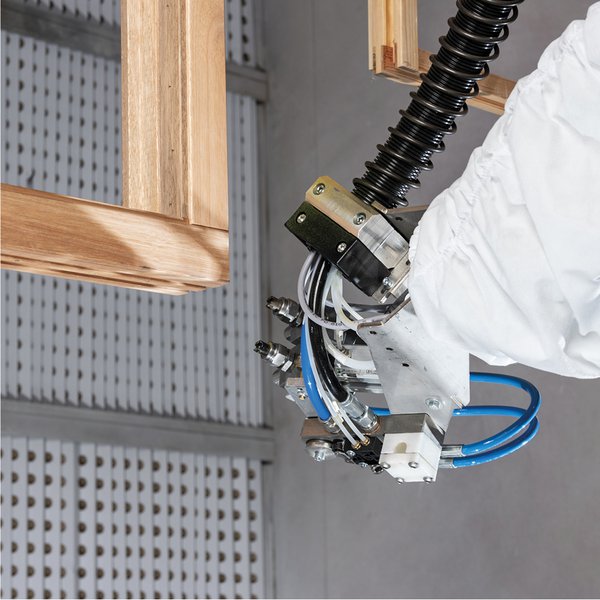
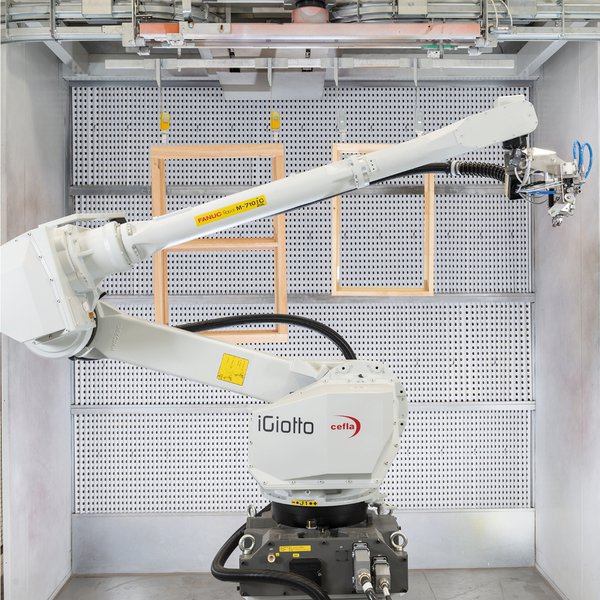
iGiotto is, above all, a spray coating solution that can be fully integrated with special software, allowing the manufacturer to control every aspect of the spraying process. Able to work with water- or solvent-based lacquers, it features an anthropomorphic spray robot that works at programmable speeds while maintaining a stable gap between spray gun and workpiece. In essence, this set-up ensures optimised consumption of the lacquer and its uniform application.

Specially developed in-house software lets you set all the process parameters and start production, with minimal operator intervention as all the worker has to do is load the pieces onto the vertical line. Note also that iGiotto sprays the pieces as they’re being conveyed, increasing overall line efficiency.

When iGiotto is integrated into a complete line, the pieces pass through a drying tunnel and are then collected and unloaded, either in batches or individually.

igiotto-front

iFlow: wood impregnating solutions

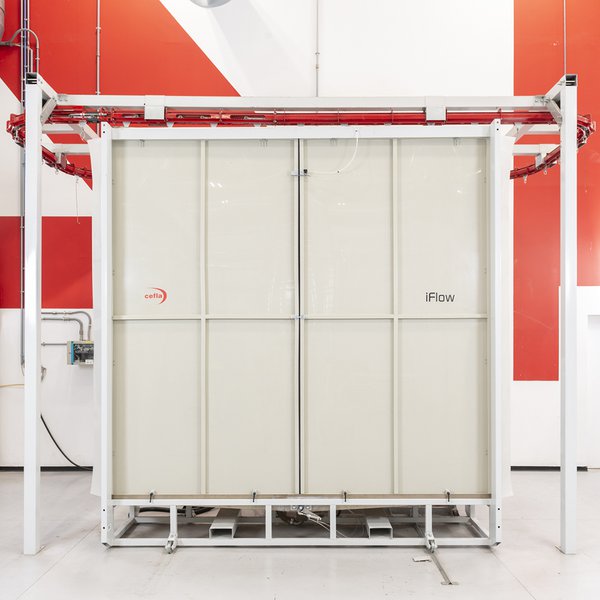
iFlow is, instead, a spray-type wood impregnation machine. Developed using ‘smart design’ principles that streamline cleaning and general maintenance tasks, iFlow is the perfect addition to lines that seek to maximise production efficiency. This coating solution is, in fact, expandable: it allows for the inclusion of a second unit to manage different types of finishes and colours within the same time frame.

iflow

Automatic loading and unloading: integration with overhead lines

A high-efficiency overhead line can only be considered complete if it features an integrated product handling system.

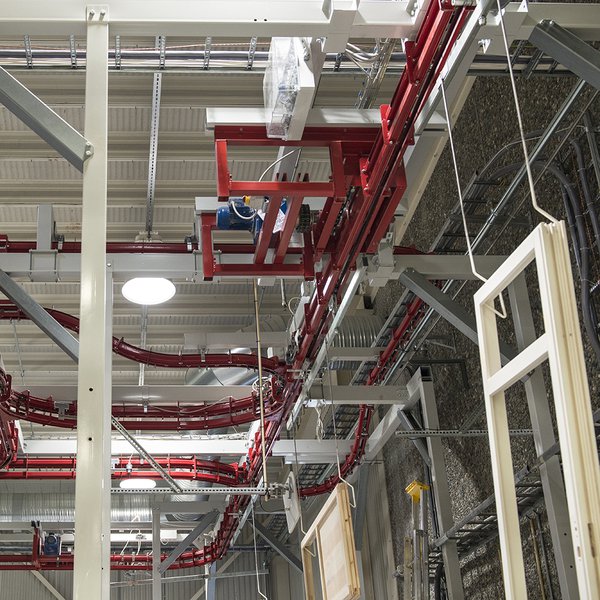
To minimise manual tasks - and allow operators to focus on supervising the line - Cefla Finishing has developed iLoad, a cutting-edge solution for automatic loading/unloading of overhead conveyors.

iload

Sustainable coating: an achievable goal

Bringing all the features of these machines together on a single coating solution doesn’t just boost plant productivity: it also significantly improves the sustainability of the entire value chain.

Less lacquer consumption - which leads to reduced use of wash water, less refuse, fewer filters and less maintenance - leads to a reduction in waste and lessens the environmental impact of operations.

Why Cefla Finishing? The advantage of being global

A global presence, combined with in-depth experience gained in highly localised situations, allows Cefla Finishing to provide unique solutions for unique needs.

Just think of how coating processes vary according to the type of wood used (conifers, broadleaved trees, exotic woods, etc.). What’s more, finishing processes are also affected by ambient conditions. For example, coating types and processes in cold countries (e.g. Scandinavian nations) will differ considerably from those used in warmer, sunnier countries such as those in the Mediterranean area. Each geographical setting has its own peculiarities, and local companies need to take them into account, as must their suppliers.

Cefla Finishing is an international player that has built its reputation by intercepting different needs on different markets: a factor that, today, makes it an ultra-reliable partner for small, medium and large companies alike.

coated windows

How to choose the right solution for your company

Established to meet customers’ individual needs, the Cefla Finishing Lab is a true technological hub that aims to pool experiences, business models and new technological opportunities.

Visitors to the Cefla Finishing Lab can see more than a hundred machines in operation, create and test entire processes on-site and pinpoint the best settings to maximise production line performance.

In other words, visiting our Lab means discovering the coating solutions that best suit your specific requirements and calculating the ROI needed to make finishing lines increasingly efficient.

LOOKING FOR THE IDEAL COATING LINE SOLUTION?


Door/window manufacturers and sub-contractors who finish intermediate wooden or PVC products are always looking for new coating solutions: integrated ...

Article

New Elispray: faster, easier to clean, less lacquer consumption


Whereas elliptical spraying techniques ensured high speeds and large volumes in the past, more recent reciprocating solutions have outpaced machines based on a rotary distribution system, especially in face of smaller production batches required by today’s market. Reliability was also an issue which played against the choice of this technology, but today’s redesigned Elispray features new, patented solutions that enable extremely high speeds, excellent transfer efficiency, reliability and reduced lacquer consumption by up to 20%.

Elliptical spray coating: superior transfer efficiency

Several factors have increased the transfer efficiency of the new Elispray. Combining a high-performance spraying booth with high-speed distribution, we have achieved excellent results. Innovations include:

  • double plenum directs overspray where it is needed, settling gradually on the workpieces instead of being forced down
  • belt surface has been increased to maximise overspray recovery
  • new layout of suction areas interferes less with overspray
  • guns operate at lower speeds than a reciprocating machine, making it possible to use lower feed pressures and waste less lacquer
All this saves the filters from dealing with excessive overspray, meaning they will last longer. Cleaning operations are much easier and faster than before.

Reliability ensures minimal maintenance downtime

Elispray features a patented product distribution system on the guns, eliminating aspects that undermined reliability in the past. A rinsing circuit also runs right next to the seals of the lacquer delivery circuit. Conveying water or solvent, it rinses, helps detect leakage points and reduces the working temperature of the joints thereby extending seal life.

The following benefits are obtained:

  • minimises defects and machine downtime caused by localised leakage
  • critical machine components can be monitored while the machine is working to avoid unproductive stoppages
  • allows companies to plan maintenance sessions without needing to react to problems which disrupt production
Also available is a patented line feeding system by means of a rotary pump, eliminating risks connected to the presence of a joint. This results in just one single lacquer circuit compared to the double circuit present on the version with a rotary joint.

Discover more on Elispray in this webinar

Whereas elliptical spraying techniques ensured high speeds and large volumes in the past, more recent reciprocating solutions have outpaced machines ...

Load more articles

Articles: 6 / 25