Magazine

Coating technologies

Article

Glass Painting and Decoration: Technologies, Applications and Advantages for Industry

The painting and decoration of glass are processes capable of transforming a noble material into a truly multisensory experience. There are several methods to achieve this transformation, each with distinct steps and characteristics that endow the glass with specific properties.
Greater resistance, more brilliance, and extensive customisation potential: these are usually the reasons why manufacturers constantly seek to improve their glass painting and decoration processes.
To maximise the outcome, however, it's crucial to consider the numerous available technologies and install production lines capable of delivering optimal finishing in line with customer expectations.

Why invest in glass painting and decoration?

Glass painting and decoration are essential to enhancing manufactured products, improving their appearance, and increasing functionality. While this is a generalisation, it holds true across the various applications enabled by this processing technique, which we’ll explore across different industries.
Investing in equipment and expertise for glass painting and decoration means positioning oneself in the construction and furniture markets with a flexible and resilient proposition. This allows companies to adapt to market trends—offering highly customised solutions—and to seize emerging opportunities from previously untapped industrial sectors.

Industrial applications of glass painting and decoration

Let’s explore today’s main applications of glass painting and decoration, highlighting why leading players in the automotive, construction, and furniture industries choose to treat this material.

Automotive

In the automotive sector, glass finishing and painting play a vital role in both aesthetics and safety.
Glass finishing enhances the vehicle's visual appeal by enabling elegant designs and bold tones. Coatings also offer protection against scratches, UV rays, and environmental contaminants, helping glass parts maintain their appearance over time.
Treated and tinted glass increases passenger comfort by reducing glare and heat while ensuring more privacy and safety. Lightweight glass, combined with innovative finishing techniques, also contributes to reducing vehicle weight, thereby improving fuel efficiency and overall performance.

Construction industry

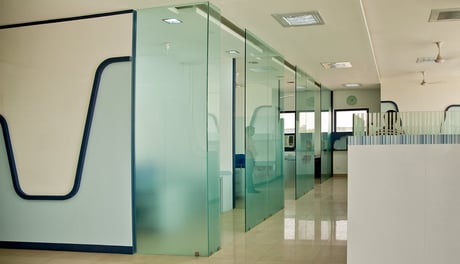
The construction industry benefits from the versatility of glass for a wide range of architectural solutions—from windows and interior partitions to building facades. But it’s not just about looks: special finishing treatments like low-emissivity coatings significantly improve thermal performance, cutting heating and cooling costs.
Painted glass adapts to architectural designs, while laminated and tempered glass enhances safety by offering better resistance to impacts and breakage—crucial for residential and commercial settings alike. Treated smooth glass surfaces are also easier to clean and maintain, reducing long-term maintenance costs for property owners.

Furniture

In the furniture industry, glass painting and decoration techniques have revolutionised how designers create functional and elegant pieces.
Glass can be shaped, coloured, and finished in various ways to craft unique furniture elements that suit a wide range of styles.
Finishing protects glass from scratches and stains, ensuring durability in high-traffic areas. Treated glass components are also less prone to harbour bacteria and are easier to sanitise—ideal for kitchen use.

Glass painting technologies

There are four main technologies used in glass finishing: spray coating, roller coating, screen printing, and digital printing. Each offers unique advantages for enhancing appearance, functionality, and durability.


INNOVATIVE FINISHING SOLUTIONS

Discover advanced finishing solutions to elevate your business.


Spray coating

Spray coating applies lacquer to glass surfaces using a spray gun on coating equipment in an integrated finishing line.
This method ensures even distribution and a smooth, uniform finish—ideal for decorative glass.
Advantages include fast colour changes, a wide range of finishes, and protective features. Most importantly, it shortens production times compared to manual methods, making it suitable for large volumes.

Roller coating

In this method, paint is applied using rollers in an automated in-line process.
It ensures uniform application, particularly suited for architectural use.

This method also provides an even and controlled paint distribution, resulting in the smooth, uniform finish on the glass that is essential for architectural applications.A key benefit is the automatic edge-cleaning effect, eliminating post-coating cleaning and speeding up the tempering process.

Screen printing

This involves using a stencil (or screen) to apply ink to the glass surface.
Perfect for complex multicolour designs, screen printing suits decorative glass, signage, and artistic pieces, also because it is possible to apply multiple layers of ink, so as to obtain depth and consistency, improving the visual appeal of the finished product.

Screen inks are UV-, chemical-, and abrasion-resistant, ensuring durability and colour retention. It’s also highly versatile, applicable to various glass types—tempered, laminated, and more—making it ideal for automotive, architectural, and consumer sectors.

Digital printing

Inkjet technology prints high-resolution graphics directly on the glass.
Ideal for customised and intricate designs, it accommodates diverse patterns, colours, and dimensions, supporting tailored projects.
This technique minimises waste (no stencils or screens needed) and shortens lead times due to rapid set-up.

Glass finishing techniques

In addition to painting, finishing techniques enhance glass’s functionality and safety. The three most common are etching, sandblasting, and film application.

Etching

Etching removes a thin surface layer to create patterns or designs—mechanically, chemically, or via laser for precision.

Sandblasting

Uses abrasives applied at high speeds to texture or smooth glass surfaces, creating uniform finishes or decorative effects.

Film application

Applies a thin vinyl or polymer film to glass for aesthetic or protective purposes.
Protective films enhance resistance to scratches and chemicals, improve energy efficiency, or increase privacy in buildings and vehicles.

Today, special paints can be applied by spray coaters or roller coaters and, once properly dried, form a film directly on the glass—streamlining the process and ensuring high-quality results.

Cefla Finishing solutions for glass painting and decoration

Cefla Finishing has identified key challenges faced by glass manufacturers and, through partnerships with global industry leaders, developed a portfolio of technologies that ensure:

  • high and uniform application quality
  • transfer efficiency
  • ease of use

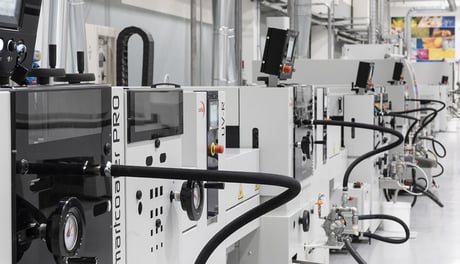
The range includes roller and spray coating machines, as well as drying solutions.

Cefla Finishing machines feature patented technologies and are engineered for ease of use. The main goal is to maximise efficiency by enabling operators, even those without specialised training, to quickly master the controls and procedures. Cefla Finishing also develops automated lines that cut down on expenses and enhance coating uniformity, which contributes to managing consumption and its associated costs.

Technologies:

  • Framecoater: Coats up to four perimetric sections of a glass sheet, thereby appearing as a frame. Avoids the need for manual coating.
  • Multicoater: Patented roller coating technology with remarkable application capacity allowing high coverage and uniformity.
  • Glasscoater: Easy-to-use roller coating machine suitable for ceramic glazes and organic products. Maximum reliability and application uniformity.
  • Prima Glass: The ready-to-go spray solution to automate your glass decoration process. Extreme flexibility in colour changes.
  • Mito Glass: Reciprocating spray coating machine, easy to use and fit for frequent colour changeovers. Patented plenum accentuates transfer efficiency.
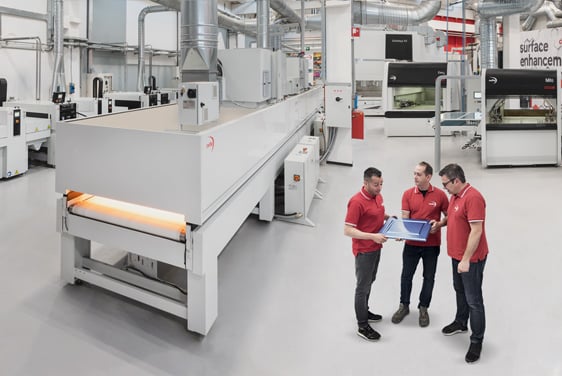
  • Glassoven: Ovens with a consolidate design, made to optimise air circulation and drying efficiency.
  • Glasscool: Cooling tunnel with high-speed air blade ventilation on both sides of glass sheet.
  • Solarcoater: Patented roller coating technology applying anti-reflective coating with over 100 machines installed worldwide.

Looking for the ideal solution for your glass painting line?

Coating Technologies The painting and decoration of glass are processes capable of transforming a noble material into a truly multisensory ...

Article

What are the main steps of a coating cycle?

What are the main steps of a coating cycle?

Coating cycle steps

What are the main steps of a coating cycle? The process can be grouped into 5 main phases:

Sanding: sanding the untreated panel is a phase that we will find in almost all coating cycles, both when talking of wood or and other materials, such as fibre cement and some plastic substrates. In the case of a wooden substrate, it smoothes out the panel by removing the woody fibres that rise up from the surface due to humidity, while in materials other than wood, normally it improves the adhesion of the first coat of paint
Coating / impregnation: coating is the application of solvent-based or water-based dyes, which alter the colour of the substrate. Impregnation, on the other hand, has the dual purpose of both colouring and protecting against mould and fungi
Application of the primer: this is the first of a series of base coats, carried out to: clog the pores, allow sanding while preserving the colouring of the substrate, provide an optimal base for the first finishing layer
Sanding of the substrate
Finishing: application of the finishing coats, transparent or pigmented, glossy, matt, or even deep matt and soft touch. It ensures surface resistance and protection against adverse weather conditions.

IMG-LAB-W562

What are the main steps of a coating cycle? The process can be grouped into 5 main phases: ➊ Sanding: sanding the untreated panel is a phase that we ...

Article

Falling in love with complex 3D geometries again

Falling in love with complex 3D geometries again

How many times is it a love and hate game? When you need to coat a complex 3D element, the first thing that comes to mind is the time spent manually programming a sequence of trajectories which ensure both spraying efficiency and finished quality.

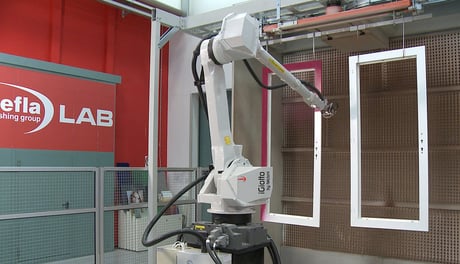
iGiotto Cefla Finishing spray coating

How many times is it a love and hate game? When you need to coat a complex 3D element, the first thing that comes to mind is the time spent manually programming a sequence of trajectories which ensure both spraying efficiency and finished quality. Window frames may not put you to the test, but spraying objects such as chairs, musical instruments, helmets or flower vases will present a notable challenge when defining specific parameters. Do you begin to hate them? Would you fall in love with them again if you could totally avoid manual programming? Think of the time saved. And imagine if you could be sure of obtaining the most efficient trajectories ensuring the best coating quality, not just once, but on every single piece.

Avoiding manual programming totally
Today’s options allow you to manually program the robot by physically guiding its spraying arms around the complex geometrical shape. The robot learns how to move and replicates the movement piece after piece. You can also program point-to-point trajectories using a software off-line, but an intelligent 3D scanner built into the spraying robot will mean you can just admire the results without even thinking of manually programming your equipment. This is exactly what the new cVision 3D scanner provides: a solution which avoids the need to manually program your anthropomorphic robot. This means no time at all spent defining trajectories. It’s all done automatically. The cVision scanner acquires the 3D image of the piece to be coated and uses its special software to determine the best trajectories. You save time, can be sure of obtaining optimal parameters and achieve consistent coating quality from the first piece to the last.

Do you want to try our cVision system?

How many times is it a love and hate game? When you need to coat a complex 3D element, the first thing that comes to mind is the time spent manually ...

Article

Can quality really cost 30% less?

Can quality really cost 30% less?

This is a question that comes and goes, usually getting a negative response because saving money inevitably means a compromise which reduces quality.

iBotic Cefla Finishing

This is a question that comes and goes, usually getting a negative response because saving money inevitably means a compromise which reduces quality. But if your business profits rely on cutting overheads, especially in the form of electricity, or if you can obtain incentives by implementing sustainable technologies, you cannot stand still, you need to make a choice. When you’ve already opted for quality, you will be using a spraying robot such as iBotic. Thinking of saving money would probably lead you to consider reverting to an oscillating spray coater or even hand-coating the pieces in a spraying booth. Neither options will conserve the finished quality of the spraying robot, so where do you look?

Introducing the PowerBack System

So far, no one building spraying robots has succeeded in developing a special hardware and software architecture to enable energy savings on a Cartesian spraying robot. Energy retrieval generated through deceleration of the spraying arms is used to help power the outlet fan. This new technology is the key feature of iBotic’s PowerBack System and saves between 15 and 30% on energy costs compared to the iBotic without PowerBack.

Contact us to find out more about the PowerBack System

This is a question that comes and goes, usually getting a negative response because saving money inevitably means a compromise which reduces quality. ...

Article

Our LAB Experience

Our LAB Experience

LAB Finishing experiences

✓ 25 years of LAB experience
✓ 3000 square metres of space
✓ 85 machines


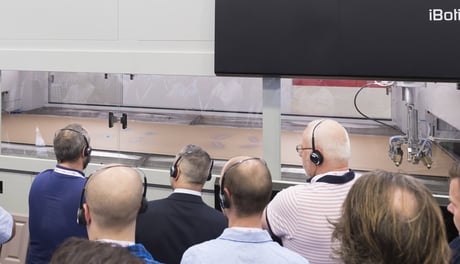
Let us start right here with the first chapter of the experience gathered by our team of finishing professionals in the Laboratory where our technicians, customers and paint suppliers carry out the tests, pre-empting industrial tests, on the solutions we provide to the market, trying out the processes and experimenting with new technologies.

Over the coming weeks, LAB Manager Eduard Raffini who has been in charge of the LAB team since 1995 and handles both the machines and the lines, will tell us the best ways to run tests.

We will take a close look at the phases of each process, from the preparation of the substrates (sanding, rusticating, brushing), to the adhesion treatments (flaming or primers, impregnations and base coats, sanding), up to the glossy, opaque or textured finishes, with a porous effect or deep matt.

There is a constant made up of variables:
▷ Each customer has specific needs
▷ Each customer has their own products
▷ Each customer has their own processes

Everyone wants to improve the business, evaluating finishing technologies, different machines, more efficient processes. It is the passion that drives time and time again to reach the best solution.

Contact us and arrange a visit to the LAB. 

Eduard Raffini

LAB Application Manager

Test specialist and Coordinator of the Cefla Finishing HQ LAB

https://www.linkedin.com/in/eduard-raffini/

✓ 25 years of LAB experience ✓ 3000 square metres of space ✓ 85 machines Let us start right here with the first chapter of the experience gathered by ...

Article

Outdoor furniture from an insider point of view

Outdoor furniture from an insider point of view

iGiotto outdoors furniture finish

Today, everything starts at home. With most families in communities around the world spending more time at home in 2020, there has been an unprecedented surge in demand for outdoor furniture. Outdoor furniture is known by a variety of names: garden furniture, patio furniture, lounge furniture, and conversation sets. Popular examples include dining sets, conversation sets, lounge chairs, portable fire pits, umbrellas, Adirondack chairs, even glazed planters to accessorize the area. Common materials range by region, purpose and personal preference: wooden, bamboo, wicker or rattan, metal, plastic, glass, concrete, and rope.

The finish of outdoor furnishings is important, considering the endurance needed to battle environmental impacts. UV rays, precipitation, wind and humidity are all factors that should be considered from a manufacturing standpoint – as the longevity of a finish, in addition to the quality of construction, is what ultimately determine a product’s lifespan.

Automating the finish of outdoor furniture improves consistency and quality throughout the production process. Depending on the geometry of the part, a number of automated finishing technologies can be deployed to quickly and consistently pump out product to meet production demands. For example, iGiottoApp is a unique 3D spray technology that utilizes an anthropomorphic robot to finish not only the face of a part, but its negative angles as well. iGiotto is ideal for large objects, and objects with unique geometries. Alternatively, for disassembled furniture components that are boxed upon delivery, reciprocating spray systems can achieve a consistent, quality finish at a high speed of production. Both types of spray technologies can be integrated with curing and material handling components to minimize the amount of times each part is touched – minimizing defects and labor costs.

Contact us and discuss your needs with a finishing expert!

Today, everything starts at home. With most families in communities around the world spending more time at home in 2020, there has been an ...

Load more articles

Articles: 12 / 20